

Almost every adult over 40 who walks into our studio brings something with them — a knee that complains on stairs, a shoulder that hasn't been right since a fall, hands that ache in the morning. The most common assumption is that this rules out strength training. Usually it's the opposite: it's the reason to train, with the right modifications and the right people involved.
Before anything else: this is general education, not medical advice. If you have a diagnosed joint condition, a recent injury, or pain you haven't had assessed, start with your physician or a physical therapist. Everything below assumes you've done that.
Why strength usually helps a painful joint
A joint doesn't carry load on its own. The muscles crossing it share the work, and when those muscles are stronger, the joint surface absorbs less of it. That's the basic reason quadriceps and hip strength are so consistently associated with better function in people with knee osteoarthritis, and why clinical guidelines for managing osteoarthritis generally include exercise rather than rest.
There's a second effect that matters just as much. Joints are nourished by movement — loading and unloading circulates fluid through cartilage that has no blood supply of its own. Prolonged rest tends to make stiff joints stiffer.
The instinct to protect a sore joint by not using it is understandable and, past a certain point, counterproductive. The goal isn't avoiding load. It's finding the load, range, and tempo that the joint tolerates today, and building from there.
What "modification" actually looks like
Modification is not doing an easier workout. It's doing the same work through a path that doesn't provoke the problem. In practice:
- Change the range, not the exercise. A knee that hurts below parallel often does fine in the top two-thirds of a squat. Box squats to a controlled depth train the same muscles without visiting the angle that hurts.
- Change the implement. A barbell forces your wrists, elbows, and shoulders into one fixed relationship. Dumbbells, kettlebells, cables, and machines let the joint find a path it likes.
- Change the tempo. Slower, controlled reps with less weight often let a joint work comfortably where fast, heavy reps don't.
- Change the angle of loading. A shoulder that dislikes overhead pressing frequently tolerates an incline press without complaint.
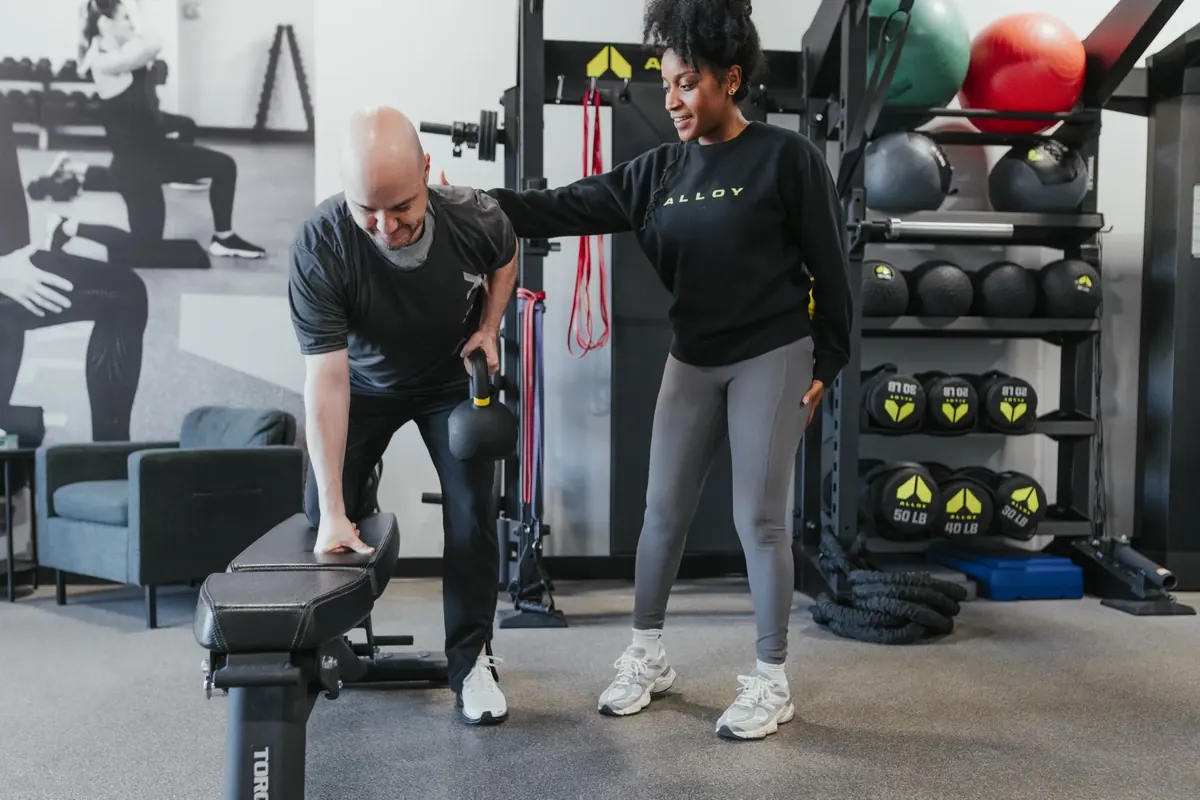
- Train around it, not instead of it. A flared-up shoulder is not a reason to skip legs. Most "I had to stop training" stories are really "I stopped training everything because one part hurt."
Reading pain honestly
You need a rough working distinction, and this is the one most coaches and clinicians use:
Usually fine to work with, while telling your coach:
- Muscle soreness spread across a muscle belly, appearing a day or two after a session
- Stiffness that eases as you warm up
- Mild, dull discomfort that stays the same through a set and settles quickly afterward
Stop the movement and get it assessed:
- Sharp, stabbing, or electrical pain
- Pain that gets worse rep by rep
- Pain localized precisely to a joint line
- Swelling, heat, locking, or a joint giving way
- Pain that wakes you up at night or is worse the next morning
- Any new pain following a specific incident
That second list is medical territory. A good coach modifies your program and tells you to go see someone — not one or the other.
Where our lane ends
We're coaches. We can build a program around a diagnosed condition, adjust it session to session, and notice when something looks wrong. We cannot diagnose you, we cannot treat an injury, and we won't pretend otherwise. When something belongs to a physician or a physical therapist, we say so — and we'd rather work alongside your PT, following their restrictions, than have you choose between us.
What we can say is that "I have arthritis" and "I have an old shoulder injury" are among the most common things we hear, not disqualifying ones. Sessions at our Winnebago Street studio cap at six, everyone trains on an individual program, and modifications are ordinary rather than a special accommodation — the person next to you is working around something too.
If you're carrying something and unsure where to begin, the Starting Point Session includes a movement assessment that looks at how you actually move, an InBody body composition scan, a sample workout, and a plan built around your history. Bring your physician's guidance with you; we'll build around it.