
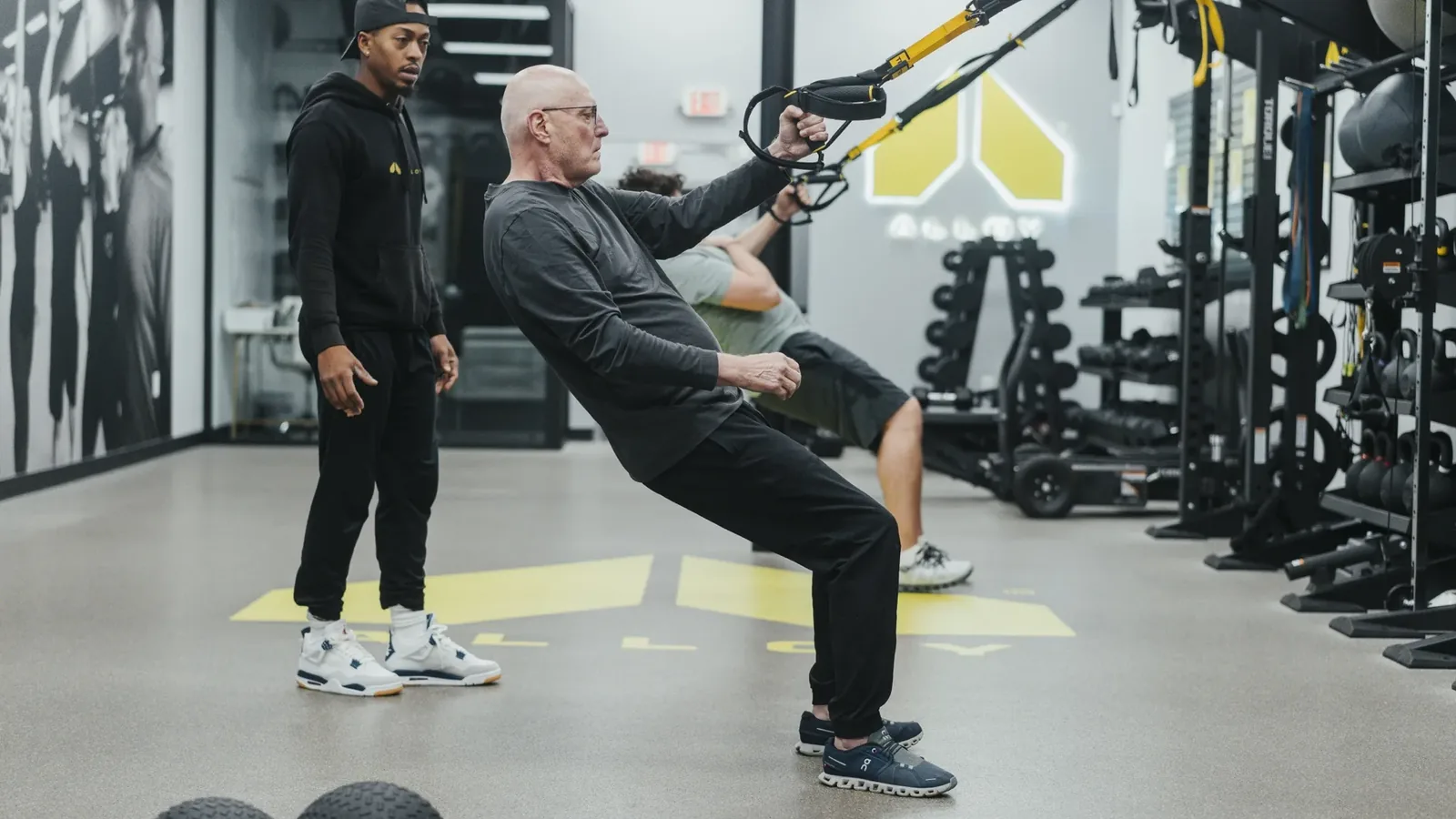
Nobody arrives at 50 with a desk-job body because of one bad year. It's the accumulation — eight or nine hours a day, five days a week, for two or three decades — and the changes are gradual enough that most people don't notice until something starts hurting.
If that's your working life, here's what's actually happening and what training does about it.
What sitting does, specifically
Not vague "bad posture." Four fairly concrete things:
- Hip flexors adapt short. Sit with hips at 90 degrees for most of your waking hours and the tissue at the front of the hip settles into that length. Then standing tall requires working against it, and your lower back often does the compensating.
- Glutes stop participating. The largest muscle group in your body does approximately nothing while you sit on it. It doesn't disappear, but it does get less willing to fire when you need it — so hamstrings and lower back cover the work.
- The upper back stiffens forward. Reaching toward a keyboard and screen for years leaves the thoracic spine reluctant to extend and the shoulders sitting forward. That's a large share of the shoulder pain that shows up in the 40s and 50s.
- The deep neck muscles lose the argument. A head that's drifted forward is heavier on the neck than a head that's stacked, for simple leverage reasons.
Individually these are minor. Combined and compounded over twenty years, they're why bending to pick something up produces a twinge that lasts a week.
Why desk stretches aren't the answer
The standard advice is a stretch break every hour. It's better than nothing, and it isn't a fix.
A thirty-second stretch produces a temporary change in tissue tolerance, not a lasting structural one. You feel looser for a while, then return to sitting, and the pattern reasserts itself. It's fighting a nine-hour input with a thirty-second output.
What actually changes the pattern is loading the muscles that sitting under-uses, through a full range, repeatedly, over months. Strength training builds usable range and the capacity to hold a position — which is what posture actually is. Posture isn't a shape you remember to make; it's what your body defaults to when you're not thinking, and that default is a strength quality.
What helps most
For someone with a long sitting history, the priorities are reasonably consistent:
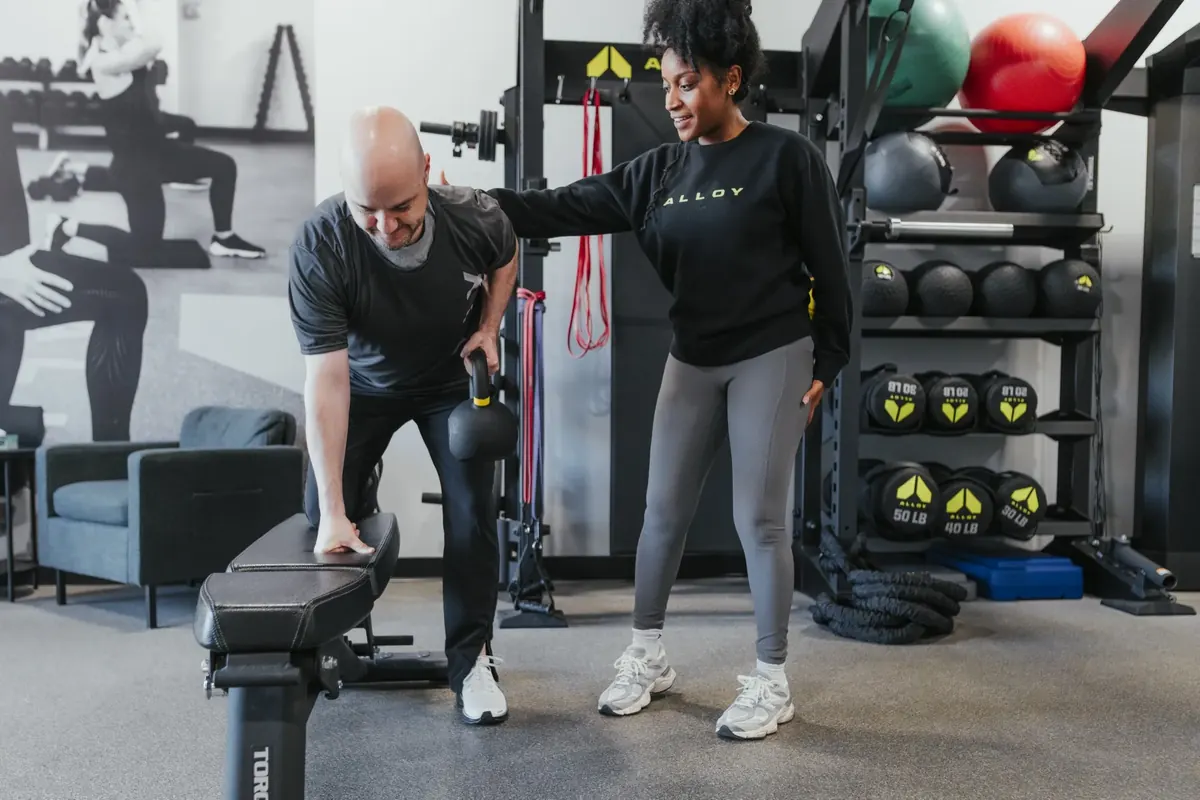
- Pull more than you push. Rows, pulldowns, face pulls. Most desk workers need considerably more pulling volume than pressing.
- Hinge. Deadlift variations, hip thrusts, good mornings — anything that teaches the glutes and hamstrings to do their job again. This is usually the highest-value category.
- Load the upper back into extension. Controlled thoracic work, overhead pressing if the shoulder tolerates it, carries with a tall posture.
- Split-stance and single-leg work. Lunges, split squats, step-ups — these open the hip on the trailing side under load, which is worth far more than a held stretch.
- Carries. Walking with weight is postural training that doesn't feel like postural training.
And separately from training: break up the sitting itself. Standing every half hour, walking to a further coffee shop, taking a call on your feet. Not a replacement for training, but it addresses a genuinely different variable.
A realistic plan for a full schedule
The most common objection here is time, and it's fair — the people with the worst desk-job posture are usually the people with the least discretionary time.
Two sessions a week is enough to change this. Not optimal, enough. Two well-programmed hours, held consistently for a year, will do more for a desk-worn body than an ambitious five-day plan that lasts until the next busy quarter.
Our studio sits on Winnebago Street in Schenk-Atwood, a few minutes from Olbrich Gardens and a straightforward stop on the way home from the east side. Sessions are booked, capped at six, and programmed individually — which matters here, because "sits all day" describes a starting point, not a prescription. Two people with the same job can need quite different work.
The Starting Point Session includes a movement assessment that shows which of the patterns above actually apply to you, plus an InBody body composition scan, a sample workout, and a plan built around the hours you really have.