

Every September in Madison, gyms fill up with people who mean it. Every February, attendance quietly collapses. The gap between those two facts is where most fitness progress in Wisconsin goes to die — and it has very little to do with how much anyone wants it.
Why winter breaks routines that worked fine in October
It isn't weakness. Several genuine things stack up at once:
- The light disappears. By December, sunset in Madison lands before 4:30. A workout you were happy to do after work in September now happens in what feels like the middle of the night.
- Everything takes longer. Scraping the car, the extra layers, the drive that takes fifteen minutes instead of eight. A 45-minute session becomes a 90-minute commitment.
- Energy genuinely drops. Reduced daylight affects sleep timing and mood for many people, and low energy at 5pm is a real physiological state, not an excuse.
- The seasonal off-ramps arrive. Holidays, travel, a stretch of illness in January. Each one is reasonable on its own. Together they produce a six-week gap.
None of this is solved by wanting it more in September. It's solved by building a routine designed for February and then running it in September too.
What actually works here
The members who train straight through winter — and we watch this every year — almost all share the same few things. Not discipline. Structure.
- A booked time, not an intention. A session at a set hour with a coach expecting you is a different psychological object than "I'll go after work." One survives a dark Tuesday. The other doesn't.
- Earlier, if you can move it. Morning and midday sessions have dramatically better winter attendance than evening ones. If your schedule permits shifting in November, shift before you need to.
- Somewhere close. Distance you don't notice in October becomes the deciding factor in January. Ten minutes matters more than amenities.
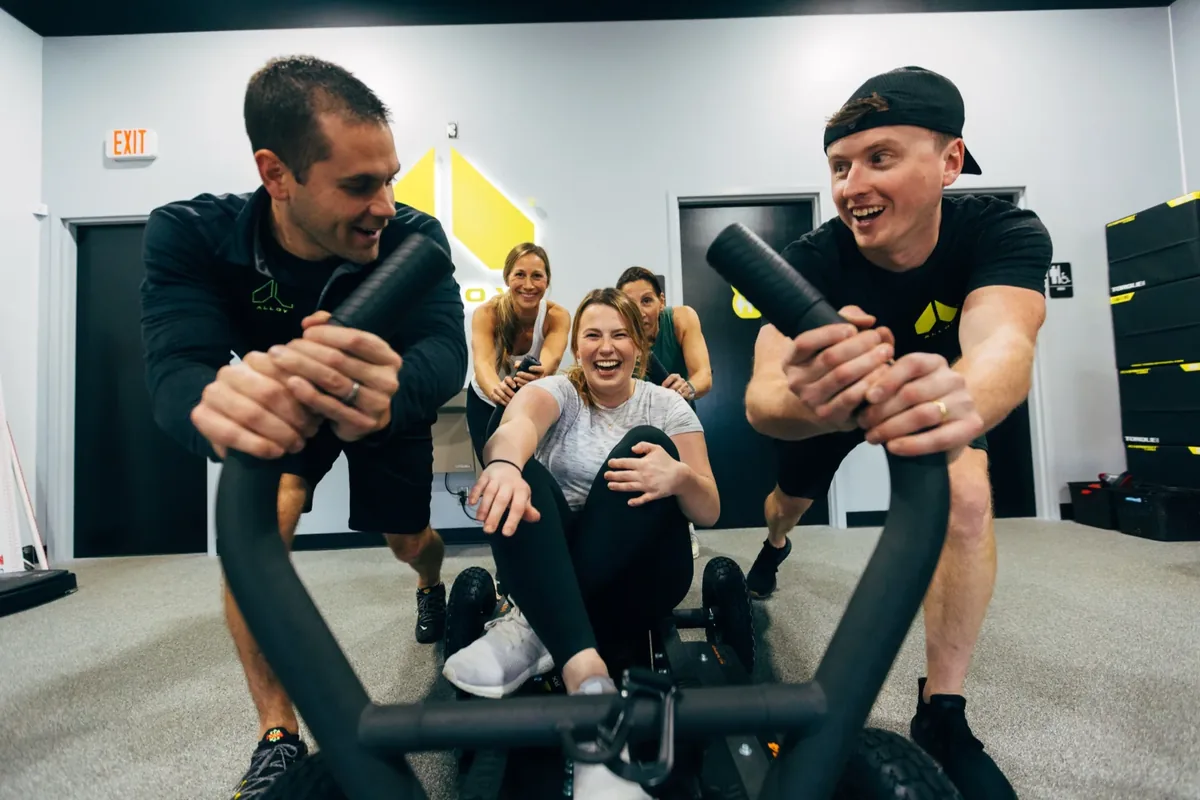
- Someone who notices. The single biggest predictor of showing up on the worst weather day of the year is whether anyone will notice if you don't. A room of six people where the coach knows your name is a much stronger commitment device than a facility with five thousand members.
- A lower bar for a bad week. One session is not a failure. Zero is how the streak ends. When the week falls apart, protect one session rather than writing off the week.
Why the winter months matter more than the summer ones
Here's the part worth internalizing: for adults over 40, the winter you didn't skip is worth more than the spring you went hard.
Muscle mass and strength decline gradually with age unless actively maintained, and that process doesn't take December off. Three months of consistent training followed by six weeks of nothing doesn't leave you where you started — it leaves you rebuilding ground you already paid for. Do that every year and you spend your forties and fifties running in place.
Meanwhile, the person who trained twice a week through February, unglamorously, without a single impressive month, is meaningfully stronger every spring than the previous one. That's the whole game. It compounds, and it only compounds if you don't reset it annually.
There's a bonus specific to this climate: strength, balance, and reaction capacity are exactly what keep you upright on an icy sidewalk. Winter is when the training pays out most directly.
A room worth walking into in January
Our studio sits on Winnebago Street in Schenk-Atwood, minutes from Olbrich Gardens and easy to reach from the east side without a highway in a snowstorm. Sessions cap at six people, they're booked at a set time, and the coaches know exactly who's missing — which turns out to be the feature that matters most in February.
If you want to start now and still be training in March, the Starting Point Session includes an InBody body composition scan, a movement assessment, a sample workout, and a plan built around the schedule you'll actually have when it's dark at 4:30.